

FASTER ASSAYS: Multichannel Microdispensing in Microtiter Plates
Microtiter plates and microdispensingmimicrodispensg
Who would think what a severe epidemic of flu in 1951 in Hungary would bring to science? Dr. Gyula Takátsy, a Hungarian scientist and virologist, needed to perform hundreds of hemagglutination tests daily. The lack of laboratory equipment led him to the idea. He machined wells on a plexiglass for serial dilution and used platinum loops instead of pipettes. In fact, 8-12 calibrated loops, which were able to reach the same at row at once. The same principle as a multichannel microdispenser. It is not daring, if we name Dr Takátsy the father of contact microdispensing.

The invention would have been almost forgotten if there hadn’t been a new discovery. In 1971, independently of each other, came Perlmann and Engvall in Sweden and Schuurs and Bauke van Weemen in the Netherlands with a new method – ELISA. Many companies started to produce microtiter plates, but with their own dimensions. This issue appeared especially with the request for automated liquid handling. Therefore, in 1995, SLAS initiated the standardisation of microtiter plates, known as the SBS microtiter plate.
Nowadays, the dimensions of microtiter plates are standardised. The footprint (127,76 mm×85,48 mm), the pitches (9 mm for 96-well, 4,5 mm for 384-well, 2,25 mm for 1536-well). The flexible parameter is the height (14,35 mm). Apart from the standard MTPs, there are also planar, shallow and deep microtiter plates. Although the last two mentioned are not entirely standard products, they have been on the market for more than 15 years. Printing microarrays into microtiter plates is no longer a scientific challenge. Challenge is the way to print and to fit to specific applications.

How to choose a proper MTP target?
To choose a certain target – MTP – always has a reason. Development of an assay is a process. Planning, preparing, validating. Scientists and manufacturers have to think ahead, which target to use, and what fits best for their applications. It is not just a piece of a piece of plastic or a paper sheet, which you can easily replace with another one. It is not a cutting board on the kitchen line.
The MTP is a valuable part of your assay and is chosen according to the intended application development and the used samples. Every single application has to fulfill its own set of requirements. From finding proper fitting substrates (polystyrene/ polypropylene/ COC/ PC/ PLA/ etc.), thinking about used liquids, their binding capacity, proper temperature, to the requested throughput expectations. The surface of MTP can have variable properties in case of binding allergens, dispensing proteins, hydrogel, ink, or dispensing cells.

The assay is usually optimised for a specific target. Microdispensers should be able to adapt to the target, not the other way around. Otherwise, you are again standing at the beginning. Changing the target can have a huge impact on the performance of the whole assay.
What do you have to do again?
Re-validate your assay, recalibrate readers, verify surface tensions, check the binding capacity, evaporation rates, the liquid handling protocol or the effect of glues in fixing the plastic parts together on your biological assay performance.
Finding out if the new target works well with your assay can disrupt the whole dispensing process. You will get faster dispensing, but in fact adapting the dispenser to your purposes, you are adapting your research to the microdispenser. At the end, you are getting more work on your plate.
In many industries, the standard approach has been set up this way for a long time: adapt the application to the technology. We think about this differently. Technology should adapt to the application. How else can the technology be flexible? Precision is not enough nowadays. What satisfy R&D doesn’t necessarily satisfy manufacturing.
From changing a microdispenser to changing dispensing technology
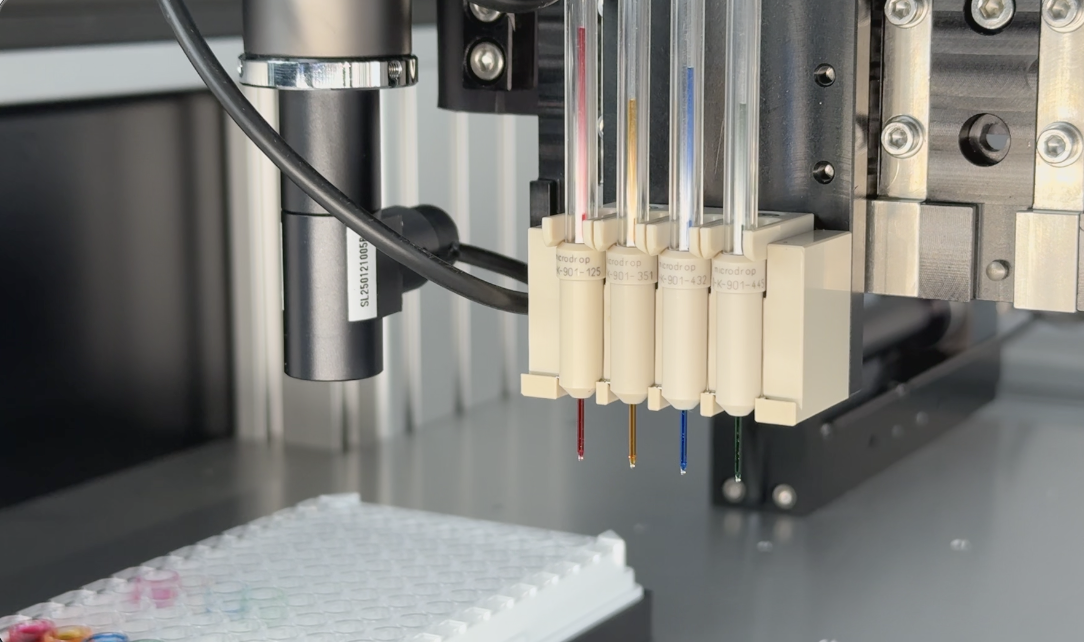
The classical technology uses x-, y-, and z-axes. With MTP, as a 3D structure, the dispenser needs to use Z-movement to get up above the well and down into the well. The extra movement is slowing the printing down. Another option is spotting from a higher distance and keeping only horizontal movement, with the risk of inconsistent dispensing or development of splashes. The third option is using multiple dispensers, multichannels. According to how many wells you need to spot into. This brings consistency in dispensing. The multichannel microdispenser also goes up and down, but prints simultaneously into several wells, which makes the spotting faster. This saves time and brings higher productivity.
Multichannel microdispenser printing in a microtiter plate
Source: https://microdrop.de
Why is adjusting the height a problem?
It is not only the speed. Although every extra movement costs time, there is also the risk of droplet misalignment caused by z-axis movement while fast printing. From this point of view, it is much safer to use multichannel if you can’t print on a flat surface. By using several channels, you come to a faster result.
As shown above, even Dr. Gyula Takátsy knew it in the fifties, when he implemented 8 “channel” platinum loops for the hemagglutination test in his handcrafted microtiter plate.
Short summary
| Traditional Technology | Microdrop Technologies |
|---|---|
| Forced Plate Migration: Changing traditional MTPs for flat MTPs to fit better with the microdispenser movement. | True Flexibility: Adapting microdispensing to MTPs |
| Slowing Down for Depth: Sacrificing speed or accuracy for standard MTP wells | Uncompromised Velocity: 1,500 – 2,000 spots/sec into any target. |
| Workflow Disruption: Re-teaching automation, re-validating assays. | Plug-and-Play: Keeping your validated plates and the speed. |