

DEAD VOLUME IN MICRODISPENSING – LIQUID EFFECTS AND BEST PRACTICES
Part 2
How can dead volume in microdispensing be reduced?
In the previous article, we wrote that one option is to optimize the nozzle geometry. Which other possibilities are available?
Surface coating
Surface coating is the next possibility for lowering dead volume – using internal coatings, hydrophilic or hydrophobic, depending on the dispensed sample. And of course, active purging methods like pulse pressure, which break surface tension and move the liquid from dead-end areas. Imagine a bottle of ketchup, the difference between shaking the ketchup out of the bottle and squeezing the bottle. The disadvantage of a surface coating is the release of the coating over time due to usage, and the dispensed sample can potentially contain a small part of this coating material, which could influence the final results.
Why does the dead volume depend on the liquid?
The dead volume differs from liquid to liquid, and will be different if dispensing water, ethanol or protein solution. It is important to know the physical properties of the spotted samples – viscosity, surface tension, wetting/contact angle, volatility, adsorption etc.
Viscosity
Higher viscosity liquids resist flow more than low viscosity liquids and tend to leave thicker residual films and more volume in the nozzle.
Hydrogel microdispensing droplet of 5nl volume, dispensed by microdrop Technologies
Surface tension, contact angle, and wetting
These properties determine how the liquid interacts with the internal surface of the nozzle and the targeted surface where the droplet should be placed. A well-wetting fluid (low contact angle) tends to form a thin continuous film, which is harder to remove. Non-wetting fluids may leave less continuous residue, but more isolated droplets. In microdispensing, liquids tend to stick to the inside of nozzles and channels, leaving small amounts behind. Proper active flushing of the microdispenser removes the residues from the nozzle and prevents the possibility of carry-over.
Adsorption and surface interaction
Certain liquids or biomolecules stick to internal surfaces and can partially remain inside the nozzle due to surface interactions. This leads to higher apparent dead volume compared with simple test solutions. These materials can cause clogging of the nozzle, in the worst case, blocking, breaking, or damaging the nozzle. To prevent this, proper material should be used for the nozzle or, if not possible to change the material, that coated surface. The coating should be regularly renewed.
Volatility
Highly volatile substances, such as ethanol, evaporate very quickly at small volumes. During gravimetric or optical measurements, some of the dispensed liquid may evaporate before being measured, making it appear that less liquid was dispensed or creating uneven residue patterns that complicate volume assessment. Mainly see at contact dispensing procedures, where the liquid is handled on the outside of the dispenser tip.
Rheology
Dispensing performance measured with water or other Newtonian liquids (ethanol, simple buffers, low sugar solutions) may not reflect behaviour with real assay reagents that have non-Newtonian flow properties. In fact, most of the biological reagents have non-Newtonian behaviour.
Best practices for measuring dead volume
The key to measuring dead volume is using the sample, which will be dispensed. Or a sample that matches the viscosity and surface tension of the sample. Maintaining controlled temperature as viscosity and surface tension are temperature sensitive. This is very important to think about, in case of a lab with an unstable room temperature within a season. Run multiple cycles to get valid results.
Dead volume in microdispensing is influenced by both system design and liquid properties. While geometric dead volume is fixed by the hardware of the nozzle, the effective dead volume seen in practice depends on surface interactions, liquid behavior, and measurement conditions. Accurate evaluation, therefore, requires testing with representative samples under controlled conditions and good tuning.
Next to this, the proportional loss is a very important parameter. This will return every time a wash procedure is started for the nozzle.
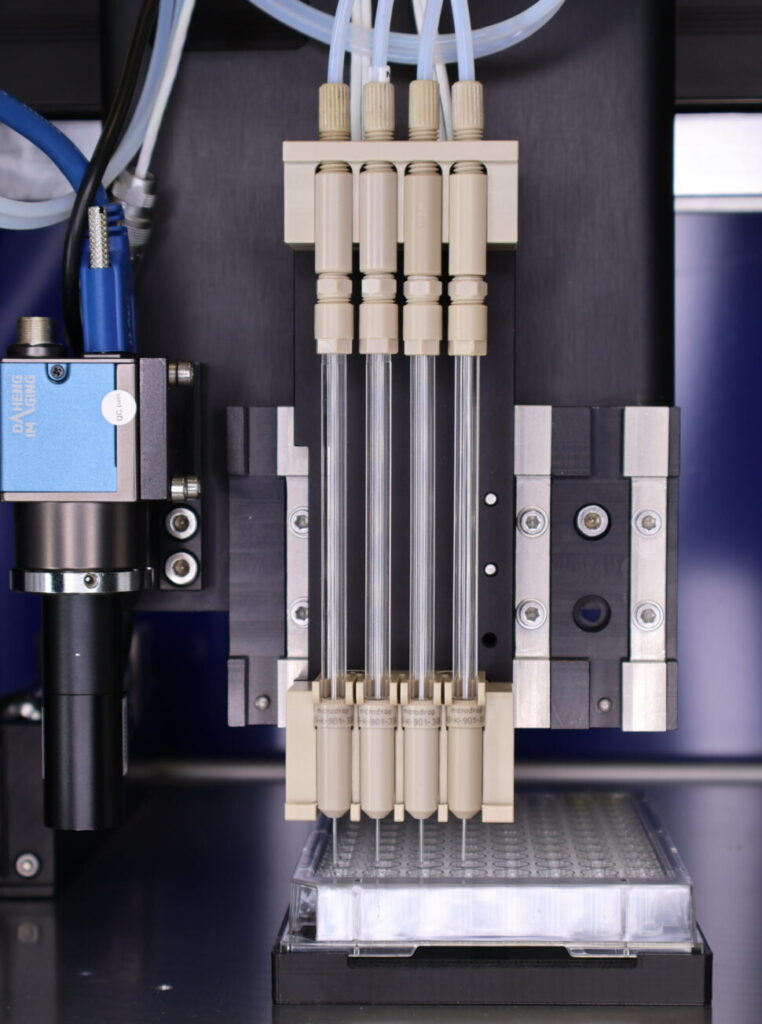
In case the Dispensing Instrument doesn’t use a system liquid, the remaining sample (dead volume) can be recovered by the instrument – sample recovery, where traditional ultra-low-volume Liquid Handling Instruments don’t have this option due to contamination & dilution by the liquids interface sample/ system liquid.