

PRECISION MICRODISPENSERS IN MODERN PIEZO TECHNOLOGY
How Modern Piezo Technology Enables Reliable Ultra-Low Volume Liquid Handling Applications
Over the past few decades, the demand for miniaturization and precise liquid handling has grown rapidly. From scientific research experiments to daily life in health care diagnostics and industry. Industrial production and production of diagnostic tests require accurate, precise, fast, reliable, and repeatable placement of liquid volumes with continuous quality control.
Why choose a piezoelectric microdispenser?
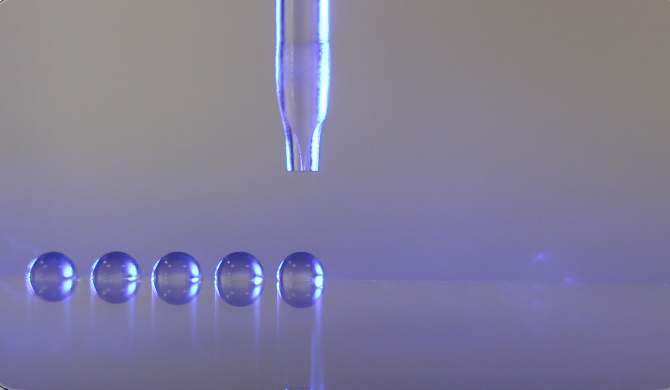
The best choice for precise and accurate droplet dispensing is a non-contact piezoelectric dispenser. By using piezo-based actuation, these microdispeners deliver droplets with exceptional accuracy and repeatability. Every drop is placed exactly where it should be, with the expected volume, size, and concentration, drop after drop.
Another advantage is the positioning of the droplets with the absence of any physical contact between the microdispenser and substrate. No contact of the surface means no up and down movement of the Z-axis during dispensing on planar surfaces. This simplifies height adjustment of the microdispensers, improves placement accuracy, and significantly reduces the risk of damaging the sensitive surface of the target.
From valve-based systems to modern piezo actuation
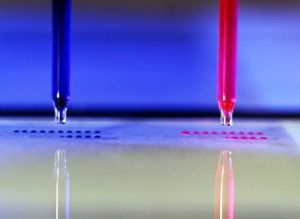
Earlier generations of the microdispensers were based on piezoelectric valves that quickly open and close to eject liquid on a substrate. Such a valve is extremely accurate, but achieving the desired dispensing volume requires careful tuning. Even the smallest changes in valve geometry – such as after cleaning or maintenance – can affect performance. Next to this, repeated rapid opening and closing of the valves leads to heating of the valve. This might have an impact on the sample – its quality, spot size or placement.
The heating of the valves was the key limitation in ultralow volume liquid handling and in IVD at the applications where enzymes or proteins were dispensed. On the other hand, nowadays it is possible to avoid this issue with smart drive electronics or a different construction of the microdispenser. Solenoid valve microdispensers have their place at nanoliter and higher volumes, with a better ability to handle viscous samples.
The latest approach in ultra-low volume microdispensing
The latest piezoelectric dispensers take a different approach. Instead of valves, they use a ceramic piezo actuator mounted around a glass capillary. A short electrical pulse causes the ceramic to contract, generating a pressure wave that ejects a droplet from the capillary. This design is highly reliable, maintenance-free, and exceptionally precise, enabling consistent dispensing of identical volumes over billions of repeated cycles.
Designed for ultra-low volumes
Today’s piezo microdispensers are very flexible in their applications. Using chemically inert borosilicate glass capillaries, they cover a volume range from about 20 picoliters up to low microliters, with operating frequencies of up to 2,000 droplets per second.
Droplets are formed by a rapid pressure pulse, enabling fully non-contact dispensing and protecting both the dispenser tip and the target surface. The microdispenser offers a flexible dispensing range – often at least twice the minimum achievable volume- while the orifice diameter plays a crucial role in defining droplet size, as it is on the same scale as the droplets themselves.
Despite the small dimensions, these capillaries do not require special handling. For more challenging applications such as dispensing highly viscous liquids, particle-containing samples, or cells, larger orifices or heatable dispensers can be used to prevent clogging and protect sensitive materials. With the right configuration, even demanding samples like membrane proteins, peptides in DMSO, highly hydrophilic solutions, or cell lysates can be dispensed reliably.
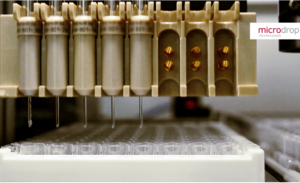
For higher throughput, options such as “spot-on-the-fly” operation or multichannel dispensing can be implemented. Standard microdispensers typically hold around 70 µL to 1 mL of liquid, with optional bulk reservoirs extending capacity to 12 mL or more.
Why optimization matters
Dispensing may look simple, but in practice, every application is different and needs a specific approach. Droplets can behave very differently, ranging from complete spreading to minimum wetting. Depending on the sample properties, contact angle, temperature, or humidity. Controlling droplet mobility is a crucial aspect for achieving spot precision, a key requirement in microarray production.
Small inconsistencies – like fluctuations in liquid, air pressure, or partial capillary clogging – can disturb the flow of liquid. This can lead to the development of satellite droplets or damaging the glass needle. Changes in operating parameters may also result in excessive adhesion or reduced droplet size. This is why selecting the right dispenser geometry and continuously monitoring the ejection process are so important. Inbuilt quality control of the properly spotted is almost a must.
Preserving concentration and sample integrity
In some dispensing systems, aspiration, speed and internal mixing zones can influence sample concentration. Diffusion between adjacent liquids may create concentration gradients that affect reproducibility. The concentration gradient can be reduced when the printing buffer is aspirated before aspiration of the sample. The best way to avoid these diffusion-related effects is to use a microdispenser without system liquid. Such a microdispenser not only avoids changing the sample concentration but also lowers the amount of gas bubbles. No air means no bubble. Fewer interfaces mean fewer diffusion-related changes, fewer air bubbles, and more consistent results.
Special thanks to our business partner Microdrop Technologies for kindly sharing the photos and video featured in this article.