

MICRODISPENSING: FROM CURIOSITY TO MODERN TECHNOLOGY
Miniaturization matters more than ever
There was a time when microliters were small. And it was not a long time ago. If a microliter was once a small volume, nowadays it is a picoliter, and in the future it might be a femtoliter. Currently, microliters are big pipettes, and microdispensing is no longer a niche area. Microdispensing is becoming as common as pipetting was. It is a modern technology for modern companies.
The dispensing of ultra-low volumes is important for labs and companies developing microarrays, biosensors, diagnostic assays, or lab-on-a-chip systems. All these laboratories and manufacturers have something in common – they need precision, repeatability, and reliability. They need to save time and precious samples.
Despite this, we at PP TechSales, often meet customers who ask: “Do we really need to go so low? Isn’t it too complicated? Will it really help us?” These questions are very common as the path from manual pipetting to fully automated dispensing might be thorny.
Might be and doesn’t have to be. In the next series, we will explain what to expect, what to avoid, and what the benefits are. Switching to automation and miniaturization saves not only costs but also time. As with any other change, starting with microdispensing needs good tuning and consideration. Selecting the proper dispensing system and technology will directly affect the accuracy, reproducibility, long-term efficiency, and cost-effectiveness of the dispensing process.
First, a bit of history
From our point of view, the biggest boom of ultra-low volume dispensing started with the need for COVID-19 testing. The market was pushed to develop as many as possible reliable tests in a relatively short period. The COVID-19 pandemic affected the production of many other diagnostic tests, for diseases, biomarkers, genetic aberrations, or residues.
The year 2019 wasn’t the year of microdispensing. Already in 1983, Tse Wen Chang used the term “array”, in this case, an arrangement of antibody spots on small glass or plastic surfaces. In the late 1980s, there was an idea of analysing multiple hybridization targets in parallel by applying them to a filter with a defined pattern.
Nevertheless, the biggest impact on microarray development was the research on DNA.
Two companies were involved – Affymax, founded in 1989, mainly interested in high-throughput drug discovery methods, and Affymetrix. Since January 1989, there was a vision of preparing millions of peptides by using the same method, like computer chips. In 1995, the researchers from Stanfort University published the first study, where the word ‘microarray’ was used for the first time. The samples in the study were printed by high-speed robot on a glass and the instrument consisted of the arrayer and scanner. The arrayer was a variation of the standard “pick-and-place” robot. In those days, there was no commercial producer of microarray spotters available. Currently, there are possibilities to equip a laboratory with an arrayer, ranging from R&D to huge production instruments. With dispensers and pins capable of placing droplets of several picolitres, nanolitres, or microlitres, with the ability to handle different viscosities or volatility.
There is always a solution for your application.
What is microdispensing?
Microdispensing is a controlled release of a very small volume on a specific surface. Volume ranges are between picoliters to low microliters. If you compare the pipetting with microdispensing, then the pipetting looks like pouring teaspoons with high precision. Microdispensing looks then like printing liquid pixels on a surface, or in the case of contact dispensing, you can compare pipetting to squeezing a bottle with ketchup on fries, while a toothpick (pin) places tiny ketchup dots on a French fry. Imagine a teaspoon, volume of 5 ml, and compare it with a microdrop of 5 picoliters, which is a factor million smaller than a teaspoon volume.
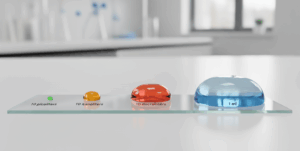
| Range | Volume |
| Microliter | 10⁻⁶ liter |
| Nanoliters | 10⁻⁹ liter |
| Picoliters | 10⁻¹² liter |
| Femtoliters | 10⁻¹⁵ liter (we will see what future brings) |
Anyway, microdipsensing is not only about the volume and size. The most difficult are the parameters connected to the low volume of the real biological sample. Real samples do not behave the same as the ideal, model liquids with model properties.
Real samples show tensions between the liquid and surface, have different water affinities, wetting angles, viscosity, and require different temperatures or nozzle orifice sizes. All these and many other properties have an impact on successful microdispensing. And this is also the reason why it is necessary, before buying a new dispensing system, to request trial printing with your own, real samples. The investment is not inconsiderable, and proving that dispensing is successful will save many future sorrows.
Microdispensing didn’t become real because someone liked small drops, it happened because people refused to let a droplet win.