

CONTACT vs. NON-CONTACT MICRODISPENSING
A Practical Overview for Modern Bioassay and Microarray Production
In the previous article, we tried to explain what microdispensing is and that there are other features equal to, or even more important than, the droplet’s size and volume. In this article, we will explain the general differences between contact and non-contact (sometimes called contactless) microdispensing.
What is contact dispensing?
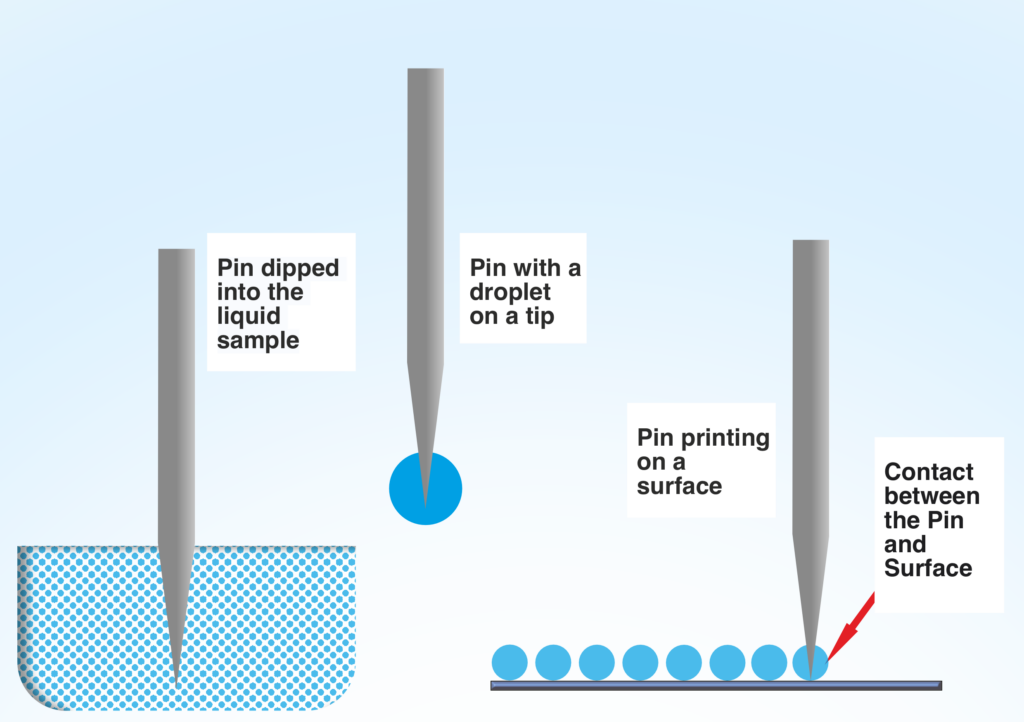
Contact microdispensing is a technique that is based on direct contact between the tip, the sample, and the surface. This method is based on the physical properties of these three items. The geometry of the tip is essential for the volume of the spot, which is usually from microliter to nanoliter volume. Picking up of the sample is caused by capillary elevation. When the pin is dipped into a sample, the capillary forces draw a small amount of the liquid upward, which is going to be printed.
The volume of the elevated liquid depends on the material of the pin and its construction, and will be different for capillary, split, or solid pins. The droplet size has to be tuned upfront by choosing a proper size of the pin and adjusting the frequency of touching the surface and reloading the liquid sample. Otherwise, the spots are inconsistent, volume or size is changed, or the spots are missing. This technique is popular for a high amount of different samples, very viscous, or difficult to spot. It is less recommended for methods that need high precision, exact volume, and in case there is no recovery check.
What is non-contact microdispensing?
Non-contact microdispensing is based on delivering droplets of small volume, using volume displacement technology with high accuracy. The tip of the dispenser doesn’t come into direct contact with the surface, only with the sample. In fact, the droplet is ejected onto a surface in a controlled volume from picoliter to low microliter. Depending on the flexibility of the dispenser, there can be created different patterns, from simple drops to line, circle, square patterns, or the drop can be placed into another drop, microneedle or sensor.
The dispensers are manufactured in different ways, mostly with a piezo-electric actuator. The principle of the piezo ceramic is the change of shape after applying voltage. The actuator expands and shrinks, and this movement drives valves, which open and close themselves, and due to this, eject precise volumes. Another possibility is acoustic droplet ejection, which works with ultrasonic waves. The ultrasonic pulse is sent through the fluid, a small droplet is developed and falls off. Other possibilities include aerosol jets or ink jets, a flow-based dispensing technology that works similarly to a water-tap flow with moderate accuracy.
The non-contact microdispensing is a popular method at IVD, biotech, and everywhere, where you need precision in positioning, reliability in drop-volume, and no cross-contamination. Printing is possible on any surface, which is an advantage for printing on microneedles, biosensors, or surfaces that are not flat. On the other hand, this method is not the preferred one in case of thousands of different samples.
Let’s figure out the difference between contact and non-contact microdispensing
| CRITERION | CONTACT | NON-CONTACT |
|---|---|---|
| Volume range | pico – nanoliter | pico – low μliter |
| Highly viscous samples | Yes | Depends on a dispenser |
| Sample dead volume | Moderate to high | Very low |
| Contact with surface | Yes. Risk of surface damage. | Yes. |
| Precision | Depends on a pin | Very good |
| Clogging | Depends on a pin | Occasionally |
| Cross-contamination risk | High | Low, depends on technology |
| Sample recovery | No | Possible, depends on technology |
| Amount of samples | Thousands | Limited |
| Capital & maintenance cost | Moderate | Higher |
How to decide
The above-mentioned criteria are the main differentiators between the contact and non-contact microdispensing. The requests for different dispensing methods depend on the application. There are different requests for dispensing allergens compared to dispensing glue. Different if dispensing 5 biomarkers or 500 different biomarkers. Different if dispensing highly clogging material or ethanol, or DMSO solution. This is necessary to reconsider upfront, not only the chosen method, chosen dispenser, but also the calculation of how long the whole dispensing process takes. Not to calculate only the speed while printing, but also the time spent on cleaning the dispensers, the precision of the printing and the repeatability of the dispensing process. The droplet volume, quality of the dispensed droplet, position quality, and finally the ability to check the quality of the dispensed microarray by image-based quality control software.
All these properties are necessary to know upfront, as they have a big impact on your array production, competitiveness on the market and the final price of your product.
Special thanks to our business partner Microdrop Technologies for kindly sharing the video featured in this article.