

DEAD VOLUME IN MICRODISPENSING – OVERVIEW AND MEASUREMENT
Part 1
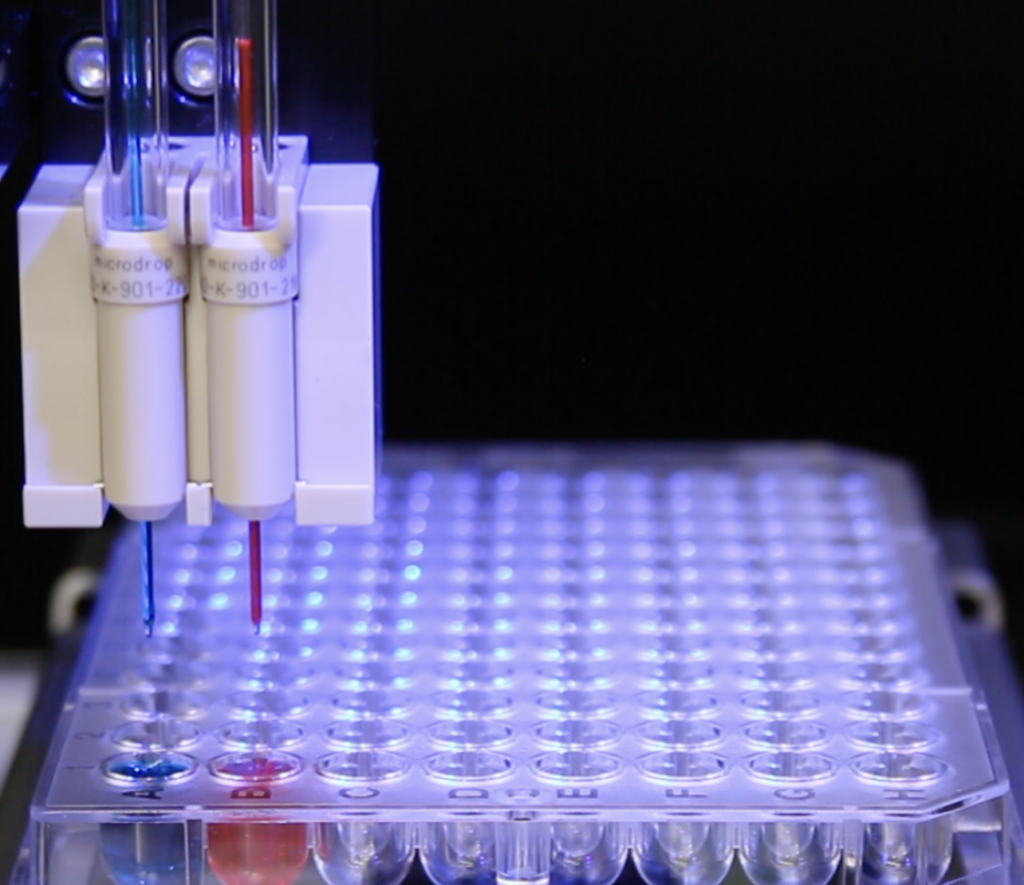
What is Dead Volume and its impact on microdispensing?
In the context of a dispensing pipette, dead volume refers to the amount of liquid that remains trapped inside the capillary of a pipette/ nozzle. This amount cannot be removed during the dispensing procedure. Residual liquid stays in the pipettes or channels after the dispensing is complete. When the dispensed volumes are extremely small, any retained liquid represents wasted material and potential performance risk. Even less than one microliter dead volume is a significant value loss in the case of pico- and nanoliter dispensing.
Why does the dead volume matter?
Dead volume directly affects both cost efficiency and dispensing performance.
First of all, material waste. Precious and expensive samples are not used and are wasted. The bigger the dead volume, the more sample amount will not be used and will stay left behind in the nozzle. Risk of contamination and carryover – improper cleaning of the capillaries causes mixing with another sample or reagent. So, the samples can get diluted or even spoiled. Next to this, a bigger dead volume means more flushing of the nozzle and using more system liquids. Instead of spending time on dispensing, the time is spent on cleaning. Additionally, there is also a higher operational risk. The material can accumulate and contribute to a lack of dispensing precision and nozzle clogging.
Droplet released by a microdispenser from microdrop Technologies
Where does dead volume come from?
Dead volume is caused by the geometry of the nozzle, including its internal diameter and length, the valve structure, and the fitting interfaces. Changing the nozzle design also changes the dead volume.
Nonetheless, it is important to distinguish between real dead volume, which is caused by the geometry of the dispensing nozzle, and apparent dead volume. The apparent dead volume is caused by surface interactions, evaporation, air bubbles, or rheological properties of the dispensed liquids. Apparent dead volume depends on the dispensed liquid and on the measurement method. The apparent dead volume doesn’t represent the real internal volume of the nozzle.
How is dead volume measured?
For this purpose, it is possible to calculate the estimated dead volume of a nozzle by using a formula:
Total Volume = πr2H
This calculation shows the estimated total internal volume of the nozzle. Dead volume is obtained by subtracting the total volume from the dispensed volume. The amount released by dispensing can be recalculated from a known volume of the spot or weight on an analytical balance.
Dead Volume = Initial Fill Volume – Released Volume
Typically, the dead volume is at the glass nozzles between 10-20 μl, while using solenoid valves, the value can be higher.
Proportional loss: 15 μl : 40 μl * 100% = 37.5 %
How can dead volume be reduced?
Optimizing nozzle geometry
One of the options is minimizing the internal diameter and length. The internal volume (the amount of liquid inside the nozzle) and the dispensed volume per drop (amount of liquid released per actuation) are largely independent in piezo / jetting technology. Reducing the internal nozzle diameter lowers the amount of liquid trapped inside the dispensing nozzle without limiting the dispensed droplet volume. In fact, the actuation parameters control the droplet volume, rather than the storage volume. Despite the smaller internal storage volume, the relative remaining dead volume part in the dispenser stays nearly the same. It is approximately 15μl of dead volume. On the other hand, a Piezo dispenser with an internal reservoir volume of 1ml means that the proportional loss of liquid in the dead volume is around 1,5%. It means, a bigger reservoir saves biological material.